
Wheezing at night? Child allergy and asthma care in Salunke Vihar, Kondhwa at Vertex Clinics helps families work out why a child keeps coughing, sneezing, itching or struggling to breathe, and what can be done about it. Our paediatric team listens to the pattern of symptoms, looks for triggers at home and school, examines your child and explains the findings clearly. We then agree on a practical plan, including what to give daily, what to keep for emergencies and when to come straight to us.
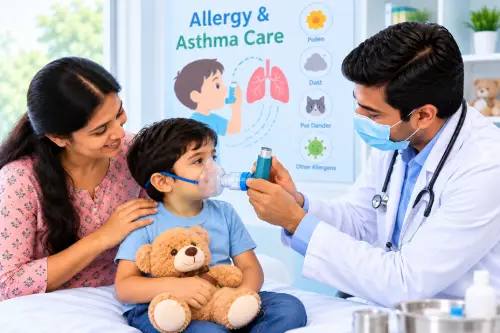
Colds usually pass within a week to ten days, while allergy and asthma symptoms come back again and again, follow a pattern and often cause itching, night cough or wheeze.
| Clue | More likely a cold | More likely allergy or asthma |
|---|---|---|
| Duration | Settles within about 7 to 10 days | Lasts weeks or keeps returning |
| Fever | Common | Usually absent |
| Nose | Thick, coloured mucus | Clear, watery, with sneezing and itching |
| Cough | Improves day by day | Worse at night, with exercise or cold air |
| Wheeze or chest tightness | Occasional, with infection | Repeated, even without a cold |
| Eyes | Mild redness | Itchy, watery, rubbed often |
| Family history | Not relevant | Often a parent or sibling with allergy, asthma or eczema |
Asthma is a long-term condition in which the airways in the lungs become inflamed and sensitive, causing episodes of cough, wheeze, chest tightness and breathlessness.
Between episodes, a child may seem completely well, which is why asthma is sometimes missed. In young children, wheezing with colds is common, and not every wheezy child has asthma. We look at the pattern over time before making a diagnosis.
Repeated cough or wheeze, particularly at night, early in the morning, with exercise, laughing or crying, or when around dust, smoke or cold air, can be signs of asthma.
Other clues include:
Common triggers include viral infections, dust mites, pollen, mould, smoke, air pollution, pets, strong smells, cold air, exercise and, for some children, specific foods.
In many Indian homes, triggers also include incense, mosquito coils, cooking smoke, firecrackers and seasonal pollution. Triggers differ from child to child, so a careful history is more useful than any single test.
Keep the home smoke-free, wash bedding regularly in hot water, reduce dust-collecting items, fix damp walls and use ventilation while cooking.
Practical steps:
You do not need to turn the home upside down. Start with the changes that fit your child’s known triggers.
Besides asthma, children often have allergic rhinitis (hay fever), eczema, hives and food allergy, and several can occur together.
The mainstay is regular moisturising, gentle skin care and avoiding triggers, with prescribed creams during flares.
Use lukewarm, short baths, mild cleansers and generous moisturiser at least twice a day. Please avoid steroid creams from the chemist without advice, since strength and duration matter. Persistent, severe or infected skin conditions may need a skin specialist, and we guide you on the next step.
Swelling of the lips, face or throat, trouble breathing, repeated vomiting, dizziness, pale skin or collapse soon after exposure to a food, medicine or sting need emergency care immediately.
Do not wait to see if it settles. Go to the nearest emergency department or call for help at once. If your child has been prescribed emergency medicine, such as an adrenaline injector, use it as instructed and still go to hospital.
Treatment combines avoiding triggers, a quick-relief inhaler for symptoms, and, for children with frequent symptoms, a daily preventer inhaler to keep the airways calm.
| Reliever | Preventer (controller) | |
|---|---|---|
| Purpose | Quickly opens the airways during symptoms | Reduces airway inflammation over time |
| When used | During cough, wheeze or breathlessness | Regularly, as prescribed, even when well |
| What to expect | Relief within minutes | Fewer episodes over weeks |
| Key point | Needing it often is a warning sign | Do not stop without medical advice |
Inhalers, used with the right spacer or mask, are the best way to deliver the medicine directly to the lungs. They are not addictive, and preventers used at prescribed doses are considered safe for children. Our team teaches parents and children how to use them properly, since poor technique is a common reason for poor control.
It is a simple written plan telling you what to give every day, what to do when symptoms increase and when to seek emergency help.
Many families find it helpful to keep a copy on the phone and share another with the school.
Seek urgent care if your child is breathing very fast or with effort, cannot speak or feed properly, has blue or grey lips, is unusually drowsy or the reliever inhaler is not helping or is needed more often than every four hours.
Please see our Emergency Paediatric Consultation page for guidance on urgent care.
Yes. Well-controlled asthma should not stop a child from running, swimming or playing, and most children can take part fully.
We advise on warm-ups, using the reliever before exercise when prescribed and informing teachers, so that your child’s reliever is always at hand. Related guidance appears in our School Health Check-ups service.
Diagnosis mostly rests on history and examination. Lung function tests may be used in older children, and allergy tests such as skin prick or blood tests are considered when they will change management.
Allergy tests must be interpreted with your child’s history. A positive test alone does not prove an allergy, and random “food panels” can lead to unnecessary dietary restrictions. We advise tests only when they help.
Some children do improve with age, especially those with mild, viral-triggered wheeze, while others continue to need long-term management.
Regular follow-up shows which way your child is heading, and treatment can be reduced when it is safe to do so.
Yes. Keeping vaccines up to date, including yearly influenza vaccination, helps prevent infections that can trigger asthma, and a healthy weight, sleep and activity also support better control.
See our Complete Vaccination Services page for more.
Start with a pediatrician who looks at the whole child and knows their history, and involve a skin or allergy specialist when a problem is complex or persistent.
Many parents search for the Best Pediatric Dermatologists In Salunke Vihar, Kondhwa when eczema or rashes will not settle. Vertex Clinics is not a dermatology clinic, but we assess and manage common childhood skin allergies and guide referral when specialised care is needed. Others look for the Best pediatrician in Salunke Vihar, Kondhwa, so that coughs, colds, allergies and growth can all be followed by one trusted doctor. Families also type in Best Pediatric Allergists when they want expert help with allergy and asthma. Dr. Vishal J. Kole (MBBS, DCh, DNB Paediatrics, MRCPCH, Fellowship in Neonatology), our paediatrician and neonatologist, has more than 13 years of experience and speaks Marathi, Hindi, English and Telugu. For specialised allergy testing, immunotherapy or advanced skin care, we help you reach the right specialist.
Bring a symptom diary or phone notes, any inhalers or medicines your child uses, previous reports, photos of rashes or videos of wheezing, and your questions.
A short video of the cough or wheeze is often more helpful than a description.
Yes. Allergic rhinitis and asthma are common causes of a cough lasting several weeks.
At prescribed doses, they are considered safe and effective, and much safer than repeated severe attacks.
There is no proof that such foods cause asthma. Avoid only foods that have been shown to cause a reaction in your child.
Usually not. A spacer with an inhaler delivers medicine as well, and often faster.
They may help in some homes, but they do not replace trigger control and treatment.
Not always, but eczema and allergy raise the chance. Regular check-ups help catch problems early.
Allergies and asthma can disturb sleep, play and school, but with the right plan, most children can lead active, ordinary lives. Knowing the triggers, using medicines correctly and keeping an emergency plan ready give both parents and children more confidence. If you are looking for dependable child allergy and asthma care in Salunke Vihar, Kondhwa, Vertex Clinics is ready to listen and guide you. Call +91 97303 44558 or book your appointment today.