
Looking for a child nutritionist in Salunke Vihar, Kondhwa? At Vertex Clinics, our paediatric team helps parents with the feeding questions that keep them awake: when to start solids, what to do about a child who refuses vegetables, whether the weight is on track, and which foods actually help growth. Every recommendation is based on your child’s age, growth pattern and family food habits, and it is always built around practical, home-cooked Indian meals.
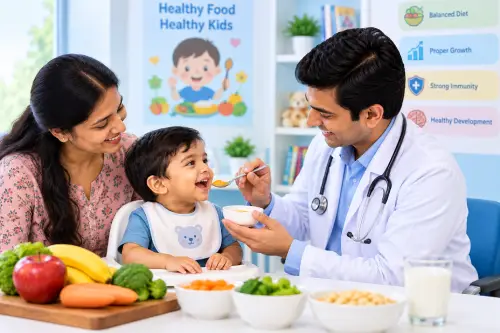
It includes a growth and weight check, a review of what and how your child eats, practical advice on age-appropriate foods, and a plan for any feeding difficulty or nutritional concern.
Our doctors look at your child’s weight, height and head size on growth charts, ask about meals, milk intake, snacks and routines, and then give simple, specific advice you can use at home.
Exclusive breastfeeding is recommended for the first six months, with continued breastfeeding alongside family foods up to two years or beyond.
Breastfed babies usually need vitamin D drops as advised by the doctor. Plain water, honey, gripe water or other drinks are not needed in the first six months, and honey should be avoided for the whole first year. If you are using formula, we explain how to prepare it correctly, since over- or under-diluting it can harm your baby.
Most babies are ready to start complementary foods at about six months, when they can sit with support, show interest in food and have lost the reflex of pushing food out with the tongue.
Starting before four months is not advised, and waiting much beyond six months can make it harder to get enough iron and other nutrients. Your doctor will confirm readiness at a check-up.
Offer a variety of soft, home-cooked foods from all food groups, gradually increasing amounts, textures and number of meals, while continuing breastfeeding.
| Age | Texture | Meals a day (approx.) | Examples |
|---|---|---|---|
| 6 to 8 months | Smooth, mashed | 2 to 3, plus breastfeeds | Rice or ragi porridge, dal water turning thicker, mashed banana, well-cooked mashed vegetables, egg yolk or egg if advised |
| 9 to 11 months | Thicker mashes, soft finger foods | 3 to 4, plus breastfeeds | Khichdi, soft idli, mashed fish or chicken, curd, steamed vegetable sticks |
| 12 to 24 months | Family foods, chopped | 3 meals and 1 to 2 snacks | Chapati pieces, dal-rice with ghee, vegetables, eggs, paneer, fruit, curd |
Each baby moves at their own pace. Start with small amounts and let your baby decide how much to eat.
Iron-rich foods such as meat, fish, eggs, pulses, green leafy vegetables, ragi, jaggery in small amounts and fortified cereals, served with a vitamin C source, help protect against anaemia.
Anaemia is common in Indian children and can affect energy, concentration and growth. We screen for it when needed and prescribe iron supplements only after assessment. Please do not start supplements on your own.
Avoid honey before one year, cow’s milk as the main drink before twelve months, added salt and sugar, sweetened drinks, whole nuts and hard or round foods that can cause choking.
Fruit juice is not recommended in infancy. Whole grapes, popcorn, raw carrot pieces and similar foods should be cut, grated or cooked until soft. Always supervise meals.
Current guidance supports introducing common allergenic foods, such as egg, peanut and fish, in small amounts around the time you begin solids, one at a time, unless your doctor advises otherwise.
If your child has severe eczema or a food allergy, or if there is a strong family history, please talk to us first. See our Allergy & Asthma Care page for more on allergy care.
Yes. Fussy eating is very common between about 18 months and 5 years, and it is usually a normal phase and not a sign of illness.
Helpful habits include:
Please see us if your child eats very few foods, gags or chokes often, loses weight or seems unwell.
After the age of one, about two to three servings of milk or dairy a day are enough for most children, and larger amounts can reduce appetite for other foods and lower iron intake.
Usually not. A varied diet gives healthy children everything they need, and most commercial health drinks add sugar without real benefit.
Supplements are advised only when there is a proven need, such as a documented deficiency or a medical condition. Please ask us before giving any product.
We plot your child’s weight, height and head size on standard growth charts over time. A child following a steady curve is usually growing well, while a sudden drop or flattening deserves attention.
Our Child Growth & Development Monitoring service tracks these measures at each visit. A single reading matters less than the trend.
Both need a doctor’s assessment to find the cause and plan safe, gradual changes, and neither should be handled with crash diets or strict restrictions.
For underweight children, we look for feeding difficulties, infections, anaemia and other causes, and we plan energy- and nutrient-rich meals. For children who are gaining too much weight, we focus on family habits: regular meals, fewer sweetened drinks and snacks, more play and less screen time, and better sleep. We avoid putting children on weight-loss diets unless a doctor specifically advises it.
A well-planned vegetarian diet can meet a child’s needs, but it needs attention to iron, vitamin B12, protein, calcium and vitamin D. Children with food allergies or lactose intolerance need safe substitutes.
We help families plan balanced meals and recommend supplements when needed.
A regular breakfast, balanced tiffin, enough calcium and iron, plenty of water, daily physical activity and limited junk food and sugary drinks.
Teenage girls especially need iron once periods begin. Our School Health Check-ups service reviews growth, vision and other aspects of health along with nutrition.
See a doctor if your child is losing weight or not gaining, refuses most foods, vomits often after meals, has frequent constipation or diarrhoea, seems pale or tired, or eats an extremely limited range of foods.
Early guidance can prevent small problems from becoming larger ones.
Choose a doctor or qualified dietitian who looks at growth, medical history and family habits together, gives practical advice and does not push products.
Parents often search for the Best Child Nutrition Consultants in Kondhwa, and the qualities that matter are medical training, an unhurried approach and advice suited to your kitchen and budget. Many also want the Best pediatrician in Salunke Vihar, Kondhwa so that feeding, growth, vaccines and illnesses are handled by one doctor who knows the child. In online searches for the Best Nutritionists, it is wise to check qualifications and avoid anyone who promises quick fixes or sells supplements. Dr. Vishal J. Kole (MBBS, DCh, DNB Paediatrics, MRCPCH, Fellowship in Neonatology), our paediatrician and neonatologist, has more than 13 years of experience and speaks Marathi, Hindi, English and Telugu, so parents can discuss feeding concerns comfortably.
Bring your child’s growth records, vaccination card, a simple list of what your child ate over two or three typical days, and any medicines or supplements being given.
Photos of meals or tiffin boxes can help, too.
You can pause for a few days and try again, offering small amounts without pressure. Please see us if the refusal continues or your baby is not gaining weight.
After one year, cow’s milk can usually be the main milk, in moderate amounts, alongside a varied diet.
It is better not to. Screens distract children from hunger cues and make it harder to build healthy eating habits.
Not routinely. Your doctor will advise if your child needs a specific supplement.
Keep fixed meal and snack times, offer snacks in small portions and avoid giving sweets or milk just before meals.
No. Children’s appetite varies from day to day, so look at the week as a whole.
Good feeding habits built in childhood stay with a person for life, and every family can build them with the right guidance and a little patience. We are here to answer your questions, track your child’s growth and help you turn healthy eating into an everyday routine. If you are looking for a dependable child nutritionist in Salunke Vihar, Kondhwa, Vertex Clinics is ready to support you and your child. Call +91 97303 44558 or book your appointment today.