
Looking for caesarean delivery in Salunke Vihar, Kondhwa because your doctor has advised a C-section? You are probably wondering how the day will unfold, how much it will hurt and when life will feel normal again. Our team at Vertex Clinics walks you through each stage in plain language, from the first planning visit to the first weeks at home, so the surgery feels like a known path and not a surprise.
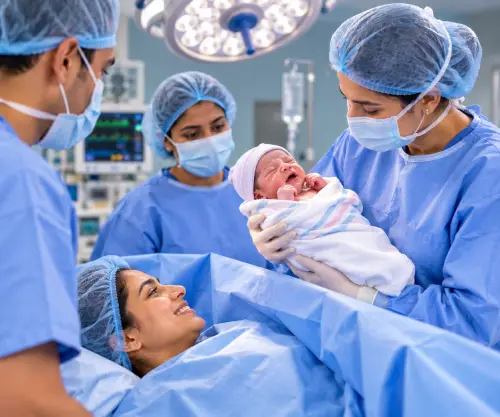
A C-section is advised when continuing with vaginal birth could put the mother or the baby at risk, either because of a known condition or because labour has taken an unexpected turn.
| Planned C-section | Emergency C-section | |
|---|---|---|
| When it is decided | Before labour, during pregnancy | During labour or a sudden complication |
| Typical reasons | Placenta lying low over the cervix, baby sideways or breech, certain twin pregnancies, earlier uterine surgery, some maternal medical conditions | Baby’s heartbeat showing stress, labour stalling, bleeding, cord problems, dangerously high blood pressure |
| Time to prepare | Days to weeks | Minutes |
Neither route reflects a failure on the mother’s part. It is a medical decision made to protect you both.
In some situations, yes. Depending on the reason, options such as turning a breech baby, careful induction of labour or a monitored trial of labour may be discussed before surgery is chosen.
For example, a breech baby can sometimes be turned from outside the abdomen near term, and about half of such attempts succeed. We review the safest route with you and, if surgery is still the better choice, we explain why.
You complete routine blood tests, meet the anaesthetist, receive fasting instructions and agree on a date, usually at 39 weeks or later unless there is a reason to go earlier.
Babies born by choice before 39 weeks can have more breathing trouble, so the date is chosen carefully. It also helps to:
Most mothers are awake under spinal or epidural anaesthesia, feeling pressure but no pain, and the baby is usually born within the first quarter of an hour.
The sequence is simple. You receive the anaesthetic, a sterile cover is placed, a low horizontal cut is made, the baby is delivered and the placenta follows. The layers are then closed one by one, which takes the longest. The whole operation typically lasts under an hour. If both of you are stable, your baby is placed on your chest as soon as possible.
You may feel numb at first, then sore, tired and sometimes shaky or nauseated, and you will be helped to sit and stand with pain medicine to keep you comfortable.
Within about a day, the team encourages short walks. Movement lowers the risk of blood clots and helps your bowels wake up. Gas pain, abdominal tightness and afterpains during feeds are common and settle with time.
Keep the wound clean and dry, support it when you cough or laugh, avoid heavy lifting for about six weeks and rest whenever the baby rests.
Practical tips from our postnatal team:
Fever, a wound that turns red, swollen or leaks fluid, bleeding that soaks a pad within an hour, calf pain or swelling, breathlessness, chest pain, a severe headache or trouble passing urine all need prompt medical attention.
Please call us or go to the nearest hospital without delay if any of these appear.
Many women go on to have healthy pregnancies, but a scar on the uterus changes the planning: we advise a gap of about 18 months and discuss early whether to try a vaginal birth or plan another caesarean.
A trial of labour after one low-segment caesarean can be suitable for selected women, in a setting ready for emergencies. The risk of placental problems rises with each additional caesarean, which is one reason we plan family size and timing with you. Our family planning services can help you choose contraception before you leave the hospital.
Your baby is checked soon after birth, and our paediatric team coordinates feeding, jaundice checks, weight monitoring and vaccinations.
Dr. Vishal J. Kole, our paediatrician and neonatologist, has trained in neonatology in the UK and has experience with premature and high-risk babies. That background matters when a caesarean takes place earlier than planned.
Look for experienced surgeons, an anaesthetist you can speak to beforehand, newborn support on site or by arrangement, and doctors who are open about both benefits and risks.
When families search for the Best Maternity Hospitals in Kondhwa, the questions behind the search are usually practical: Is there a clear emergency plan? Who will be with me during surgery? Will my baby be looked after promptly? Others type in Best Caesarean Section Surgery Doctors because they want a surgeon who recommends an operation only when it is needed. And many ask for the Best gynecologist in Salunke Nagar, Kondhwa simply because they want one doctor who knows their pregnancy from the first scan.
Dr. Ruchi N. Thakur (MBBS, MS OBGY) has more than 22 years of experience, including 14 years as Associate Professor and Unit Head at B. J. Government Medical College and Sassoon General Hospitals, Pune. Her work in a high-volume teaching hospital included complicated deliveries and surgeries, and she makes a point of explaining the reason for every recommendation.
Usually yes, because most caesareans use spinal or epidural anaesthesia. General anaesthesia is kept for specific situations.
Soreness is expected for the first few days. Pain relief is given regularly so that you can move and feed your baby.
Most mothers go home after a few days, depending on recovery.
You can usually restart light food within hours, and then return to a regular diet as advised.
It depends on the type of closure. Your doctor will tell you what applies to you.
It is a low, horizontal line that usually fades with time.
A caesarean is not the birth you may have pictured, but it can still be a calm, safe and joyful one with the right preparation and people around you. We will explain each step, stay close during surgery and support your recovery long after you leave the operating theatre. If you need caring, well-planned caesarean delivery in Salunke Vihar, Kondhwa, Vertex Clinics is ready to welcome you and your baby. Call +91 97303 44558 or book your appointment today.