
ThuLEP, or Thulium Laser Enucleation of the Prostate, is a minimally invasive laser procedure used to treat urinary symptoms caused by benign prostate enlargement. The technique uses thulium laser technology to precisely remove obstructing prostate tissue through the natural urinary passage, without the need for a large external incision.
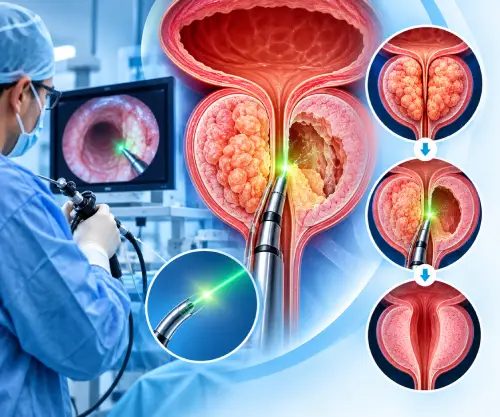
Benign prostatic hyperplasia, commonly known as BPH, is a non-cancerous enlargement of the prostate gland. As the prostate grows, it can narrow the urethra and make it difficult for urine to flow normally from the bladder.
Men with prostate enlargement may experience a weak urinary stream, difficulty starting urination, frequent urination, urgency, increased nighttime urination, or a sensation of incomplete bladder emptying.
Mild urinary symptoms may sometimes be managed with lifestyle changes or medication. However, persistent or worsening symptoms can affect sleep, daily activities, and overall quality of life.
Recurrent urinary retention, repeated urinary tract infections, bladder stones, significant bleeding, or deterioration in bladder function may indicate the need for further urological evaluation and possible surgical treatment.
ThuLEP stands for Thulium Laser Enucleation of the Prostate. It is an advanced endoscopic technique designed to remove the enlarged portion of the prostate that is obstructing urine flow.
The procedure is performed through the urethra using specialized instruments and a thulium laser. Because there is no large external incision, ThuLEP is considered a minimally invasive approach to prostate surgery.
During ThuLEP, the surgeon introduces an endoscope through the natural urinary passage. The thulium laser is used to carefully separate the enlarged prostate tissue from the surrounding prostate capsule.
The enucleated prostate tissue is moved into the bladder and subsequently removed using a specialized morcellation technique. This allows the obstructing tissue to be removed while preserving the surrounding structures.
ThuLEP may be considered for men with bothersome or moderate to severe urinary symptoms caused by benign prostate enlargement, particularly when medication does not provide adequate improvement.
It may also be considered in selected patients with significantly enlarged prostates, recurrent urinary retention, recurrent urinary infections, bladder stones, or other complications associated with prostate-related urinary obstruction.
When clinically appropriate, ThuLEP may provide several potential advantages, including:
The suitability and expected benefits of ThuLEP depend on prostate size, urinary symptoms, bladder function, medical history, medications, and individual patient factors.
Laser enucleation techniques such as ThuLEP can be used to treat selected patients with significantly enlarged prostates. The enucleation approach allows the obstructing prostate tissue to be separated and removed through the urinary passage.
The appropriate surgical approach depends on prostate anatomy, symptom severity, bladder function, previous treatments, and the patient's overall health.
Traditional prostate procedures such as TURP remain established treatments for benign prostate enlargement. ThuLEP uses thulium laser technology and an enucleation technique to remove the obstructing prostate tissue.
The choice between ThuLEP, TURP, medication, or other treatment options depends on prostate size, urinary symptoms, bladder function, medical history, and individual treatment requirements.
Before ThuLEP surgery, a detailed urological assessment is performed. Evaluation may include medical history, physical examination, urine testing, prostate assessment, urinary flow measurement, and measurement of urine remaining in the bladder after urination.
Additional investigations may be recommended depending on the patient's symptoms, prostate size, bladder function, and overall health.
Recovery after ThuLEP varies from patient to patient. A urinary catheter is commonly placed temporarily following the procedure and is removed according to the treating team's assessment.
Some patients may experience temporary urinary frequency, urgency, mild burning, or blood in the urine during the early recovery period. These symptoms generally improve as the urinary tract heals.
The primary goal of ThuLEP is to relieve obstruction caused by enlarged prostate tissue and improve urinary flow. Many patients experience improvement in urinary symptoms after recovery, although the time required for improvement can vary.
Temporary urgency or urinary leakage may occur in some patients after surgery. Appropriate follow-up and pelvic floor exercises may be recommended when required.
Follow-up after ThuLEP helps assess urinary symptoms, bladder emptying, urinary flow, and overall recovery. The removed prostate tissue is generally sent for pathological examination.
Regular urological follow-up allows the doctor to monitor recovery and address any persistent or new urinary symptoms.
ThuLEP may be an option for men whose urinary symptoms are significantly affecting their quality of life and who require surgical treatment for benign prostate enlargement.
A urologist evaluates the patient's symptoms, prostate size, bladder function, medical history, and treatment goals before recommending ThuLEP or another suitable treatment.
ThuLEP Laser Prostate Surgery is a modern minimally invasive technique for treating urinary obstruction caused by benign prostate enlargement. Using thulium laser technology, the procedure allows enlarged prostate tissue to be enucleated and removed through the natural urinary passage. For appropriately selected patients, ThuLEP can provide effective relief from urinary obstruction while supporting recovery and improved urinary function. A detailed evaluation by an experienced urologist helps determine whether ThuLEP is the right treatment option.